
Disclaimer: This guide is independent and reader-supported. When you buy through our links, we may earn an affiliate commission at no extra cost to you.
A great ceiling fan is more than just a home decor piece. It is a highly efficient air-circulation engine that can make a room feel up to 4 degrees cooler, saving you substantial money on your summer air conditioning bills.
But have you ever walked into a room and felt like the ceiling fan was either completely overwhelming the space or failing to stir even a gentle breeze?
The problem almost always comes down to sizing.
Choose a fan that is too small, and it will spin at maximum speed without cooling the room. Choose a fan that is too large, and it will create a miniature hurricane, scattering papers and looking visually massive in the space.
As a home design and interior systems specialist, I have written this comprehensive sizing guide to help you find the absolute perfect fan for any room in your home, based on square footage, ceiling height, and safety clearance requirements.

Let us start with the golden rule of ceiling fan sizing: matching the room’s square footage to the fan’s blade span (diameter).
Step 1: Calculate Your Room’s Square Footage
To find your room’s square footage, multiply the length of the room by its width in feet. For example, a 10′ x 12′ bedroom is 120 square feet. Once you have this number, use this standard architectural sizing table to determine your required blade span:
| Room Square Footage | Example Room Type | Recommended Fan Blade Span |
|---|---|---|
| Under 75 sq. ft. | Small Bathrooms, Utility Rooms, Walk-in Closets | 29 to 36 inches |
| 76 to 144 sq. ft. | Small Bedrooms, Home Offices, Breakfast Nooks | 38 to 44 inches |
| 145 to 225 sq. ft. | Standard Bedrooms, Kitchens, Dining Rooms | 50 to 54 inches |
| Over 225 sq. ft. | Great Rooms, Large Living Rooms, Master Suites | 56 to 72 inches |
Step 2: Determine Downrod Length Based on Ceiling Height
Once you know the width of your fan, you must determine its height from the floor. For maximum safety and optimal airflow, a ceiling fan must be mounted at a specific distance from both the ceiling and the floor.
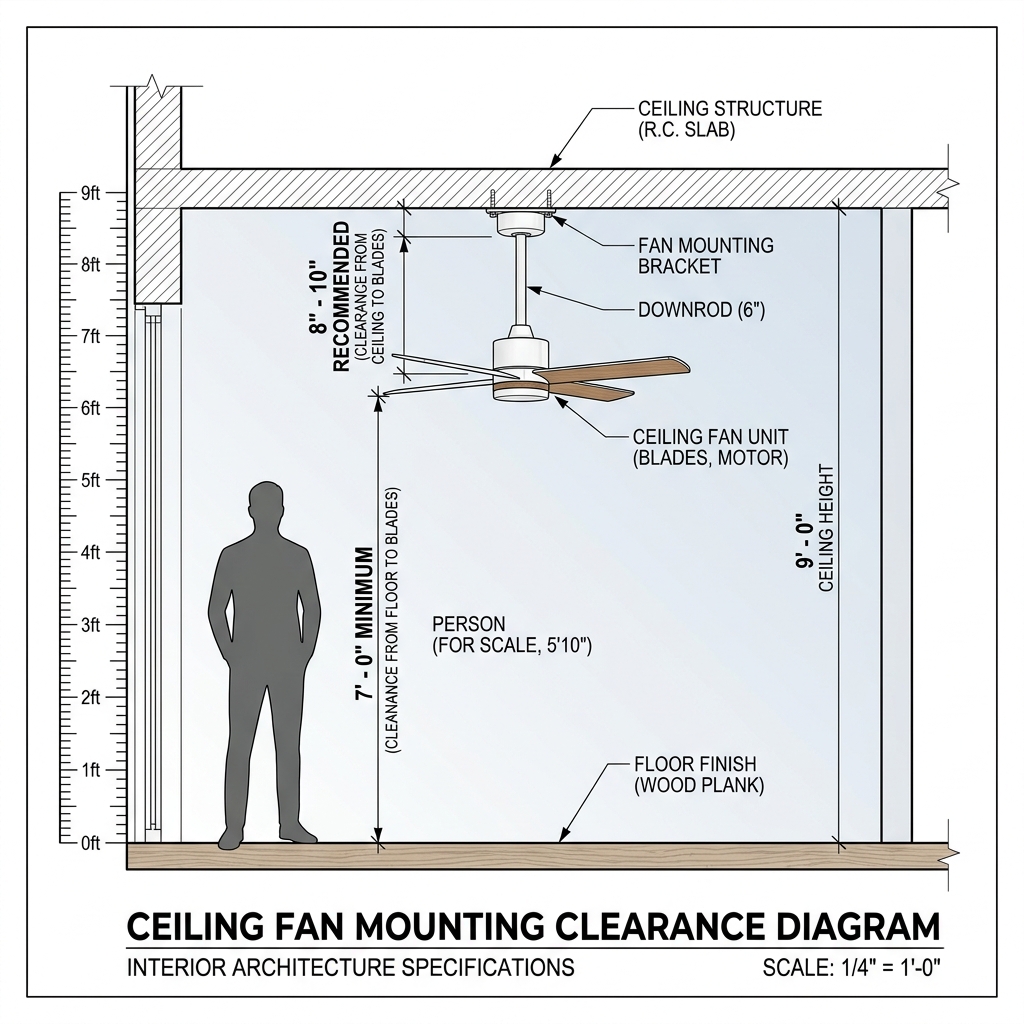
Keep these standard safety clearance specifications in mind:
- Floor Clearance: The fan blades must be at least 7 feet above the floor. If your ceiling is lower than 8 feet, you must use a “flush mount” or “hugger” ceiling fan.
- Ceiling Clearance: The blades should ideally sit 8 to 10 inches below the ceiling. Mounting a fan too close to the ceiling starves the blades of air, reducing its cooling efficiency.
- Wall Clearance: Ensure the tips of the fan blades are at least 18 inches away from any walls, doors, or cabinet doors to prevent dangerous collisions.
For higher ceilings, you must use an extension downrod to lower the fan to its sweet spot (8 to 9 feet from the floor):
- 9-Foot Ceiling: Use a 6-inch downrod.
- 10-Foot Ceiling: Use a 12-inch downrod.
- 11-Foot Ceiling: Use an 18-inch downrod.
- 12-Foot Ceiling: Use a 24-inch downrod.
Step 3: Smart Controls and Features
Modern smart fans offer conveniences that go far beyond standard wall switches or pull chains.
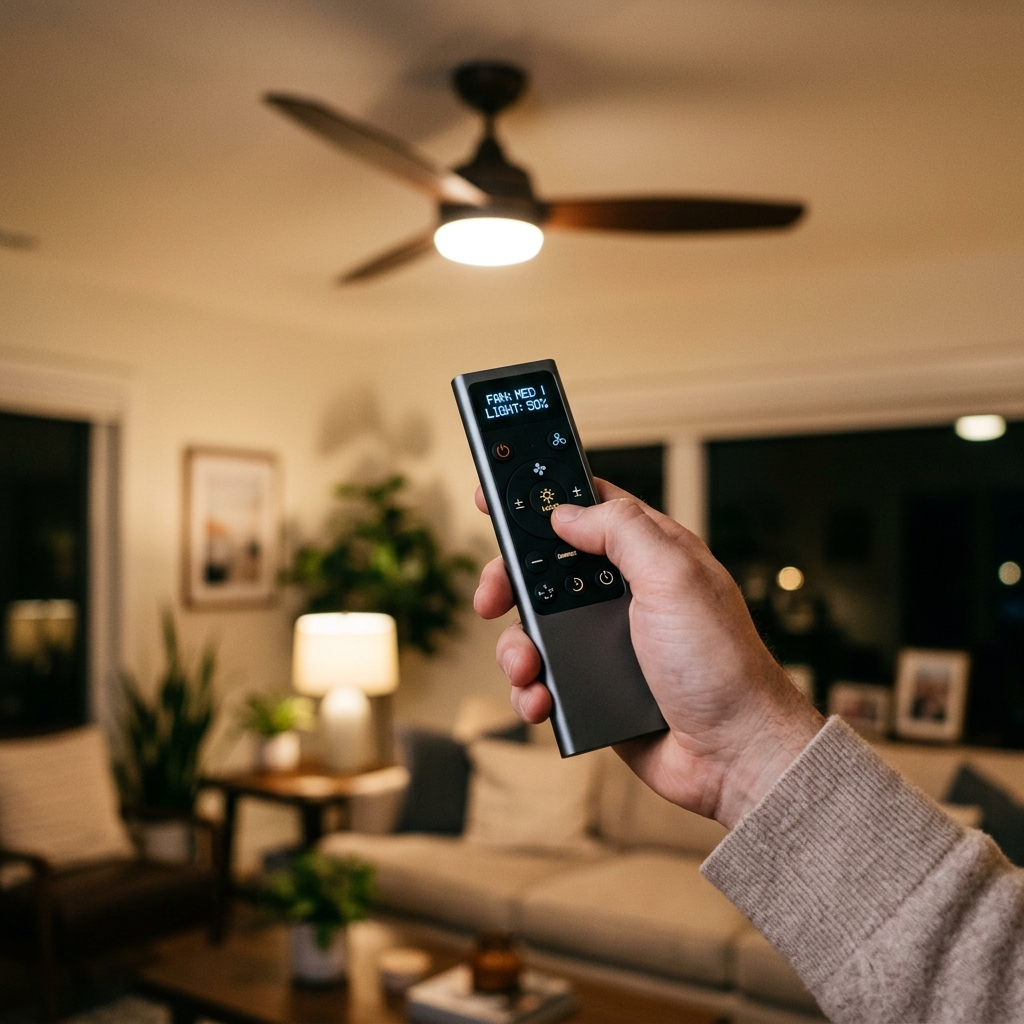
When selecting a brand like Hunter Fan, look for models equipped with handheld remotes or Wi-Fi connectivity. These smart systems allow you to adjust fan speeds, dim integrated LED light packages, and program scheduled runtimes. Many smart fans also integrate with smart home hubs (like Apple HomeKit or Google Home), allowing the fan to turn on automatically when a room thermometer reaches a specific temperature.
Final Sizing Checklist
Before clicking buy on your new ceiling fan, make sure you can answer yes to these three quick verification questions:
- Have you verified that the blade tips will be at least 18 inches away from all walls and cabinets?
- Does your ceiling height allow for a minimum of 7 feet of safety clearance between the floor and the spinning blades?
- Is the mounting location directly above a heavy-duty, fan-rated electrical junction box? (Standard ceiling light boxes are not designed to support the dynamic weight of a spinning fan).
This sizing guide solved a huge debate in my house! We have a 15×15 master bedroom with a sloped ceiling that goes from 9 feet to 12 feet. Do you recommend sizing up to a 56-inch fan to compensate for the higher sloped volume, or should we stick to a standard 52-inch fan with a longer downrod? I want to make sure we get enough airflow without the fan looking massive on a slope.
Hey Clara! That’s a classic design dilemma. Because your sloped ceiling creates a much larger air volume than a flat 9-foot ceiling, definitely size up to the 56-inch! Stick with a 12-inch or 18-inch downrod so the fan hangs low enough to circulate air efficiently in your living zone, and it won’t look too massive since the sloped space absorbs the visual height. Just make sure the fan canopy is rated for sloped installations! x — Sarah